Power banks on planes: the 2026 rules, and how to pack for them
The rules for carrying batteries on aircraft were rewritten this year, and a lot of the advice still circulating online is now out of date. The short version: power banks were separated from ordinary spare batteries, a hard 100 watt-hour ceiling is being applied to them, and the number you are allowed to carry is capped. If you own a large-capacity brick bought for a laptop or a long-haul trip, it may not be allowed in the cabin any more — and it was never allowed in the hold.
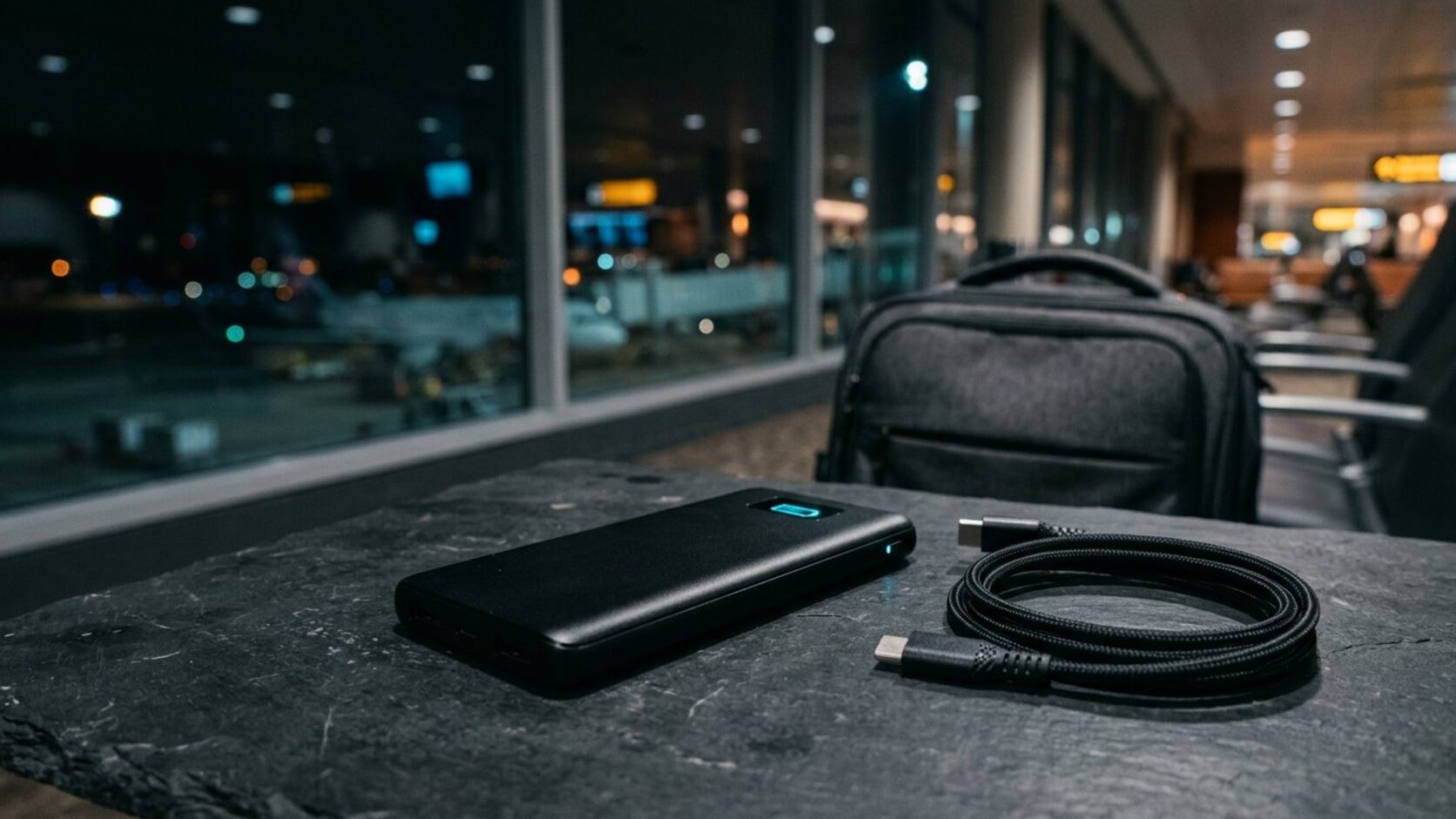
What changed in the 2026 rules
Under an addendum that took effect on 27 March 2026, power banks are treated as their own category rather than as generic spare lithium batteries. The baseline that most airlines have adopted is: a maximum of two power banks per passenger, each rated at 100 watt-hours or less, carried in the cabin only, and not recharged during the flight. Several authorities go further and expect the bank to stay within reach — in a seat pocket or under the seat bag rather than in an overhead locker, where a problem would not be noticed quickly.
The practical upshot is a rule set you can memorise in one line: two banks, under 100 Wh each, in the cabin, and do not plug the bank itself into anything on board. Charging your phone from a bank is a separate question, and a growing number of carriers restrict or prohibit it in flight, so follow the crew’s instructions.
There is one more change coming. The industry’s dangerous goods regulations move to a new edition that becomes mandatory on 1 January 2027, and the current guidance is expected to drop the approval route that has historically allowed 100–160 Wh batteries with airline permission. Plan on a hard 100 Wh ceiling for power banks from next year regardless of which airline you fly.
Watt-hours, not milliamp-hours
Almost every power bank is sold in milliamp-hours, and almost every rule is written in watt-hours. The conversion is simple: divide the milliamp-hours by 1,000, multiply by the cell voltage — usually 3.7 volts — and you have watt-hours. A 10,000 mAh bank comes out around 37 Wh. A 20,000 mAh bank is roughly 74 Wh. A 26,800 mAh bank lands just under 100 Wh, and a 27,000 mAh bank sits right on the line at about 99.9 Wh. A 30,000 mAh bank is around 111 Wh, which puts it over the limit, and a 40,000 mAh bank is around 148 Wh, comfortably outside it.
That is why the 20,000 mAh power bank has quietly become the traveller’s sweet spot: real capacity for a phone, tablet, and headphones, with genuine headroom under the cap. If you want maximum legal capacity, 26,800 mAh is the largest round number that reliably fits — but check the label, because the rating that matters is whatever the manufacturer printed, and a generous marketing claim does not override it.
What is not allowed, in any cabin
- Checked baggage. Power banks must travel in the cabin, full stop. This has been true for years, and it remains true under the 2026 rules.
- Anything over 100 Wh. The approval process that once allowed 100–160 Wh spare batteries generally does not extend to power banks under the current guidance, and carriers increasingly refuse it outright.
- Damaged or swollen banks. A bank with a bulging case, a smell, or evidence of impact should not fly at all. Do not gamble on it passing unnoticed.
- Recharging the bank on board. Prohibited under the current baseline, and cabin crew are trained to watch for it.
- Loose terminals. Exposed contacts on a spare battery are a short-circuit risk, so keep the bank in its original packaging or tape over the contacts.
Packing so you do not get stopped
Four habits prevent almost every problem at the security line. Keep the rating label readable — if the printed watt-hours have worn off, carry the specification or the original listing, because a screener cannot clear a number they cannot see. Keep the bank in your cabin bag rather than in a coat pocket or a checked bag you have already handed over. If you are asked to gate-check your cabin bag on a full flight, remove the batteries first and carry them in your personal item, because the bag is going into the hold where batteries are not permitted. And if a bank starts to feel hot or the case deforms at any point, tell the crew immediately rather than moving it somewhere out of sight.
If your cabin bag is routinely gate-checked on the routes you fly, pack as though it will happen: batteries in the smaller bag that stays with you, everything else wherever it fits.
Choosing a power bank for travel
Travel hardware should be chosen around the rule, not around the biggest number on a listing. Look for a 20,000 mAh (roughly 74 Wh) unit from a known brand with the watt-hour rating printed clearly on the housing. Check the output: USB-C Power Delivery at a useful wattage charges a phone quickly and can top up a small laptop, while a high milliamp-hour rating with weak output is a heavy object that takes all night to do very little.
Be sceptical of very cheap banks with implausible capacity claims. Beyond the obvious safety question, if the label does not match the product, the watt-hour figure you are relying on at the airport is fiction as well. And if you have been carrying the same large-capacity bank for years, check it now: it may be one of the models that quietly became a problem in 2026.
Regional notes for the US, Canada, UK, and Australia
Aviation battery rules are set internationally and then applied nationally, so the baseline is consistent in the United States, Canada, the United Kingdom, and Australia: cabin only, two banks, 100 Wh or less, and no recharging in the air. What differs is the individual airline. Several carriers, including some in the Middle East and Asia–Pacific, publish their own capacity limits and per-passenger counts on top of the international baseline, and some allow slightly larger banks on particular routes. A few US carriers allow a generous number of spare batteries while keeping the capacity ceiling.
The rule that catches people out is the local one. Check your airline’s own published policy for the exact aircraft and route before you fly, especially on long-haul international itineraries or when connecting between carriers, because the stricter of the two policies is the one that applies at the gate.
The bottom line
The 2026 changes made air travel with batteries simpler to remember and less forgiving of improvisation: two power banks, under 100 Wh each, in the cabin, never recharged on board, and never in a bag that ends up in the hold. Buy a 20,000 mAh bank from a reputable brand, keep the label legible, and you will never need to think about it at the airport again.
Questions readers ask
Can I take a 30,000 mAh power bank on a plane?
Not under the current rules. A 30,000 mAh bank works out to roughly 111 Wh at the standard cell voltage, which is above the 100 Wh ceiling applied to power banks. The 100–160 Wh approval route generally applies to spare batteries rather than power banks, and it is expected to disappear entirely from 2027.
How many power banks can I carry?
Two per passenger under the international baseline most airlines have adopted, each rated at 100 Wh or less and carried in the cabin. Individual airlines may set tighter limits, so check your carrier’s policy for your specific flight.
Can I charge my phone from a power bank during a flight?
Rules differ by airline, and the trend is toward restricting it. Recharging the power bank itself in flight is prohibited under the current international baseline. Follow the cabin crew’s instructions and check your airline’s policy before you rely on it.
This article provides general information, not legal, financial, security, or professional advice. Product terms, availability, privacy practices, and local requirements can change. Check the current information from the relevant provider and seek qualified local advice for high-impact decisions. IntelGuard may earn a commission from future affiliate links, at no additional cost to readers. Read our affiliate disclosure.